A few months ago my wife and I had some friends over for a barbecue at my house. They were (still are) a nice couple with a young son in school, whose father I had begun working with in the late summer. He was a great guy, our kids got along fine, and our wives did as well. It was a good fit all around. We had spent almost one night each weekend at each other's homes for supper and coffee for the last few months and I was beginning to see that these were folks who I could expect to know as friends for a long time.
I believe it is like that in the Army. Despite grand distances and great lengths of time between visits you will usually refer to people you've met along the way and your Army "buddies", and along with their families you think of them as friends. This guy was now my buddy, and our families were now friends.
My buddy had the honor of receiving an award in Washington D.C. at a formal reception attended by many high ranking Army officers. There were many impressive names you would know being in the army in attendance. People I refer to as "Army rock stars" when they're not around, and "Sir" or "General" when they are. He and his wife were seated next to a rock star and his wife at the gala, and the ladies were chit-chatting.
My friend was talking about all of the wonderful friends she'd made along the way traveling with her Army husband. When she said the word "friends" the general's wife began to correct her. She explained that there was a difference between "friends" and "acquaintances" and that one ought to be more distinct about who she referred to as a friend. "Friends" were lifelong companions like the ones you met in school and continue to see all the time, and what my friend encountered in her travels with her husband in the Army were "acquaintances." Apparently, she had been able to convince my friend of her point of view, for a short while anyway. Meanwhile I had been sitting across from her nervous that I might be an "acquaintance" of the only couple I had been able to make "friends" with in the area. My wife assures me that she was able to reassure our friend that we would be the type of "friends" she could look forward to having for quite a while. To this day we are really close to that couple.
I bring all this up to say that I'm very sad for that general's wife who has no friends but is proud of her large pool of acquaintances. I believe this has something to do with her involvement in her husband's career, where it is likely that she and he both are compelled to socialize with folks for professional reasons, and not necessarily to spend time with people they like and enjoy. A large part of their professional lives has bled into their personal social life. I imagine as a general there is a large part of the job that takes place outside of the office. Not necessarily on the golf course like you see in movies (although it could be possible) but at functions, ceremonies, etc.
I evaluated my own social relationships with folks I worked with using this new categorizing system of "friends" and "acquaintances." I realized that I have very few "acquaintances" (a term I've never liked using to begin with) and many many dear friends who are either my Army "buddies" or their families and I look forward to meeting with them whenever I can. I'm glad to say that I have these people in my life, even if it means I'll never get to be a general.

Even by Albany standards
Friday, June 12, 2009
I don't have a whole lot of commentary for this one but I think it's necessary to bear witness to the reindeer games going on this week in the New York state Senate. The thrust of it is that two renegade state senators have flipped the majority body upside down and bogged down the last scheduled week of the session with drama and intrigue. This last week of the session also happens to be the most important week in the legislature as the body reputedly does 30-40% of it's work during this important week. In addition to this, NY Governor David Patterson has set a state gay marriage vote in the lap of the legislature, to be voted on, yea or nay, before the session is over. But instead of earning their paychecks this week, this is what has happened...
On Monday, June 8, 2009, Democrat Senators Pedro Espada Jr. (Bronx) and Hiram Monserrate (Queens) participate in a leadership vote for the state Senate, joining with the Republican minority to form a brand new majority and naming Sen. Espada the new Senate president. They say they are not switching parties but merely voting for leadership reform. Watching this happen the Democrats try to adjourn to shut the leadership vote down, but fail. Blind-sided and probably embarrassed, the "former" Democratic majority split, leaving the Senate floor, locking the doors and shutting off the lights. Then they went to their lawyers to see if a judge couldn't give them their majority back. Here is a blow-by-blow of the Senate proceedings on Monday.
Governor Patterson comes out against the Senate and their shenanigans telling them to "act like adults" and calling the whole process "ridiculous" and "despicable" and saying they they had humiliated government "even by Albany standards" which is evidently a thing people say here in the Empire State. While he initially decided to recognize the former Senate majority leader, Malcolm Smith, he said later on Wednesday that he wanted the Senators to get back in the chamber, take a vote, and he would go with whoever they decided. He admits that he has no legal power to make things happen in this dispute. Based on communications between Governor Patterson and the state legislature, I detect that he doesn't get along too well with them, but he's no favorite of theirs either. He has been bopping them on the heads about the budget all year (and ever since he's been governor for that matter).
As of yesterday, the NY Senate has been holding sessions with 30 Republicans and the 2 Democrat defectors (dems from the former majority don't even show up), although Monserrate seems to be on the fence about his decision still. The new majority has had trouble keeping him in the chamber and it is uncertain whether he is really committed to this new coalition.
What I find spectacular is that every article you can find about this fiasco is sure to mention the iffy reputations of the two defecting Democrats. It is often announced that Senator Espada has had trouble keeping his hands out of charity funds in order to finance his political campaigns and Monserrate was arrested last year for slashing his girlfriend in the face with a broken glass. So, not exactly the classiest of characters participating in this coup, but I wonder if these two are representative of the rest of the folks working the Senate in Albany. Governor Patterson's "even by Albany standards" quote seems very appropriate.
It is also remarkable that Espada, as the newly elected Senate President, is next in line for Governor Patterson's job if anything bad should happen to him. Patterson himself seems to break the mold of a NY politician, relatively clean compared to Elliot Spitzer, his predecessor, who resigned in the wake of a call-girl scandal, and Pedro Espada Jr., the embezzling turncoat Senator who could be the governor in a heartbeat.
My larger question is: what the heck is going on in state governments? I mean, this is typically the resource pool for the manpower we get at the national leadership level, right? Not too long ago the President himself was a state senator (who himself attributes his election to the Illinois Senate to a scandal and some luck).
Perhaps I shouldn't be surprised. I'm an outsider to NY politics so this all seems very amusing, but when I reflect on the state where I was born, we elected the Terminator in a contest that also included celebrity Gary Coleman and about a thousand other candidates in a news-making circus election season. But I also have to reflect on Governor Rick Perry's antics from Texas with his recent comments about state secession and the like.
What in the world is going on?
On Monday, June 8, 2009, Democrat Senators Pedro Espada Jr. (Bronx) and Hiram Monserrate (Queens) participate in a leadership vote for the state Senate, joining with the Republican minority to form a brand new majority and naming Sen. Espada the new Senate president. They say they are not switching parties but merely voting for leadership reform. Watching this happen the Democrats try to adjourn to shut the leadership vote down, but fail. Blind-sided and probably embarrassed, the "former" Democratic majority split, leaving the Senate floor, locking the doors and shutting off the lights. Then they went to their lawyers to see if a judge couldn't give them their majority back. Here is a blow-by-blow of the Senate proceedings on Monday.

Governor Patterson comes out against the Senate and their shenanigans telling them to "act like adults" and calling the whole process "ridiculous" and "despicable" and saying they they had humiliated government "even by Albany standards" which is evidently a thing people say here in the Empire State. While he initially decided to recognize the former Senate majority leader, Malcolm Smith, he said later on Wednesday that he wanted the Senators to get back in the chamber, take a vote, and he would go with whoever they decided. He admits that he has no legal power to make things happen in this dispute. Based on communications between Governor Patterson and the state legislature, I detect that he doesn't get along too well with them, but he's no favorite of theirs either. He has been bopping them on the heads about the budget all year (and ever since he's been governor for that matter).
As of yesterday, the NY Senate has been holding sessions with 30 Republicans and the 2 Democrat defectors (dems from the former majority don't even show up), although Monserrate seems to be on the fence about his decision still. The new majority has had trouble keeping him in the chamber and it is uncertain whether he is really committed to this new coalition.
What I find spectacular is that every article you can find about this fiasco is sure to mention the iffy reputations of the two defecting Democrats. It is often announced that Senator Espada has had trouble keeping his hands out of charity funds in order to finance his political campaigns and Monserrate was arrested last year for slashing his girlfriend in the face with a broken glass. So, not exactly the classiest of characters participating in this coup, but I wonder if these two are representative of the rest of the folks working the Senate in Albany. Governor Patterson's "even by Albany standards" quote seems very appropriate.
It is also remarkable that Espada, as the newly elected Senate President, is next in line for Governor Patterson's job if anything bad should happen to him. Patterson himself seems to break the mold of a NY politician, relatively clean compared to Elliot Spitzer, his predecessor, who resigned in the wake of a call-girl scandal, and Pedro Espada Jr., the embezzling turncoat Senator who could be the governor in a heartbeat.
My larger question is: what the heck is going on in state governments? I mean, this is typically the resource pool for the manpower we get at the national leadership level, right? Not too long ago the President himself was a state senator (who himself attributes his election to the Illinois Senate to a scandal and some luck).
Perhaps I shouldn't be surprised. I'm an outsider to NY politics so this all seems very amusing, but when I reflect on the state where I was born, we elected the Terminator in a contest that also included celebrity Gary Coleman and about a thousand other candidates in a news-making circus election season. But I also have to reflect on Governor Rick Perry's antics from Texas with his recent comments about state secession and the like.
What in the world is going on?
Cap-and-trade is so hot right now.
Friday, June 5, 2009
Let me get this strait…
We cap carbon emissions as a desirable level. Then we issue tradable pollution permits. How this is done is an important step which I can address in a footnote but I’m going to move on.
The tradable permits have a price. That price determines whether it is going to be worthwhile to stop polluting or reduce emissions. If it costs less to buy a permit than reduce my emissions (technology, lost revenue), I’m buying that permit! If it costs more to buy a permit than user cleaner technology, then I’m going to clean up my plant or reduce output to control my emissions.
All this settles out to a sexy little efficient scenario where all the people who can easily reduce emissions will do so and those who can’t won’t do it. The costs of reducing emissions will the lowest it can be and the annual carbon emissions level will be set at…whatever… [edit: whatever congress/EPA feels like it should be set at]
So everybody’s good right?
Wrong. Everybody feels good. We are cutting emissions! Sure we are-in some places. In other places plants are just buying the permits so they can drive on. They pass the expense on to their customers and the bills go up in neighborhoods where the plant can’t cost-effectively lower the pollution output.
Meanwhile, while everybody has got their fuzzies from carbon control legislature, a constant flow of carbon-dioxide is going into the air albeit measured and “capped.” Perhaps it is assumed that every year we get a new atmosphere with a baseline amount of carbon-dioxide, and we can add to it a certain amount each year and then switch it out for a new one next year.
This is the Keeling Curve. It measures carbon-dioxide content of the atmosphere at Mauna Loa, HI in parts per million.
Notice something? That’s right, it goes up. More and more carbon-dioxide is put into the atmosphere every year. If you believe in the greenhouse affect and the theory of global climate change, this is a bad thing.
Okay, straw man effectively knocked out. Let me make a real argument. What if I told you the carbon-dioxide was necessary for plant life on Earth. It’s literally plant food. Plants do not exist without carbon-dioxide in the atmosphere. Well heck, put more of the stuff in the atmosphere. All that will happen is more plants will grow or they will grow bigger of faster.
Okay. Fine.
This is the Keeling Curve. Notice something? That’s right, it goes up. Which means more carbon-dioxide is going into the atmosphere. Some is getting taken out, but there is still a net increase in the amount of carbon-dioxide going up there. Carbon is going up at the rate of a smoke stack but is getting sucked back out at the pace of leaf growth. I’ve watched leaves grow. It takes a long time. Please don’t be so amused by the “cap” that you forget to ask where what’s left over is going to go.
We can argue that the biosphere will catch up...leaf growth is still growth, right? Finding the balance is the key. When we can emit as much carbon as will grow in foliage each year, there should be a balance, right? Right?
Well. What does your equilibrium state look like? (I prefer not to use loaded language, so I’ll go ahead and use images) The point is there has to be an eventual end-state to all of this extra plant food.
Something ought to be done that doesn’t just result in a steady flow of carbon each year to add to the world’s problems. The answer is reaching a carbon output level that is EXACTLY parallel to the natural amount of carbon that is naturally released into the atmosphere. That is to say: rotting detritus and chemical exchange on the surface of water. This means a switch to ZERO emission energy generation like wind and solar energy. If I must go on, I’ll do it in another segment.
For now, suffice it to say that I’m not really cap-and-trade kind of guy. Nice thought, but long-run ineffective.
I still owe you that footnote. Here goes. The question is whether the government issues permits free or auctions. I’m not going to triple-check my info for a foot-note but it looks like recent cap-and-trade legislation is talking about a mix of free permits and auctioned permits. 15% will be auctioned if memory serves.
If the government issues permits free, then NOBODY cuts emissions. They’ve got permits now for whatever they pollute. In addition to this, now they’ve got something to sell-for FREE. Environmental groups will probably be the only market for these permits which can be sold when better technology comes about to clean up pollution (which it should and will-it always does). The price will be low if not zero for these permits when they are sold.
Now auctioning off the permits actually has the desired affect of accomplishing exactly what I’ve described above. It actually does cause incentive to change technologies or find another way to lower emissions, because you’ve got to PAY to pollute. I think I also made it clear why that’s a lame idea.
Anyway, perhaps they’re thinking of a smooth middle ground. Meet up half way. Because as anyone who has passed third grade math will tell you, 15% is totally a good half-way point.
Anyhow, toodles. Sorry so long.
-SCS
We cap carbon emissions as a desirable level. Then we issue tradable pollution permits. How this is done is an important step which I can address in a footnote but I’m going to move on.
The tradable permits have a price. That price determines whether it is going to be worthwhile to stop polluting or reduce emissions. If it costs less to buy a permit than reduce my emissions (technology, lost revenue), I’m buying that permit! If it costs more to buy a permit than user cleaner technology, then I’m going to clean up my plant or reduce output to control my emissions.
All this settles out to a sexy little efficient scenario where all the people who can easily reduce emissions will do so and those who can’t won’t do it. The costs of reducing emissions will the lowest it can be and the annual carbon emissions level will be set at…whatever… [edit: whatever congress/EPA feels like it should be set at]
So everybody’s good right?
Wrong. Everybody feels good. We are cutting emissions! Sure we are-in some places. In other places plants are just buying the permits so they can drive on. They pass the expense on to their customers and the bills go up in neighborhoods where the plant can’t cost-effectively lower the pollution output.
Meanwhile, while everybody has got their fuzzies from carbon control legislature, a constant flow of carbon-dioxide is going into the air albeit measured and “capped.” Perhaps it is assumed that every year we get a new atmosphere with a baseline amount of carbon-dioxide, and we can add to it a certain amount each year and then switch it out for a new one next year.
This is the Keeling Curve. It measures carbon-dioxide content of the atmosphere at Mauna Loa, HI in parts per million.
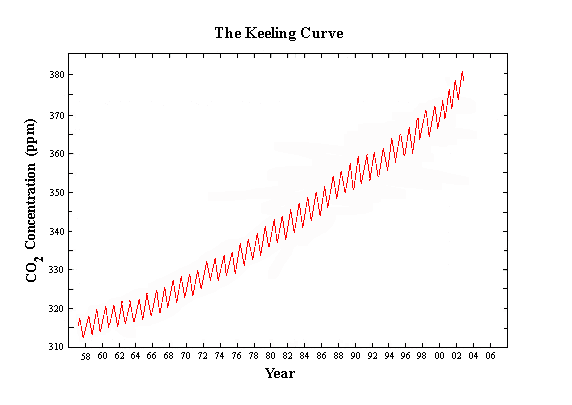
Notice something? That’s right, it goes up. More and more carbon-dioxide is put into the atmosphere every year. If you believe in the greenhouse affect and the theory of global climate change, this is a bad thing.

Okay, straw man effectively knocked out. Let me make a real argument. What if I told you the carbon-dioxide was necessary for plant life on Earth. It’s literally plant food. Plants do not exist without carbon-dioxide in the atmosphere. Well heck, put more of the stuff in the atmosphere. All that will happen is more plants will grow or they will grow bigger of faster.
Okay. Fine.
This is the Keeling Curve. Notice something? That’s right, it goes up. Which means more carbon-dioxide is going into the atmosphere. Some is getting taken out, but there is still a net increase in the amount of carbon-dioxide going up there. Carbon is going up at the rate of a smoke stack but is getting sucked back out at the pace of leaf growth. I’ve watched leaves grow. It takes a long time. Please don’t be so amused by the “cap” that you forget to ask where what’s left over is going to go.
We can argue that the biosphere will catch up...leaf growth is still growth, right? Finding the balance is the key. When we can emit as much carbon as will grow in foliage each year, there should be a balance, right? Right?
Well. What does your equilibrium state look like? (I prefer not to use loaded language, so I’ll go ahead and use images) The point is there has to be an eventual end-state to all of this extra plant food.


Something ought to be done that doesn’t just result in a steady flow of carbon each year to add to the world’s problems. The answer is reaching a carbon output level that is EXACTLY parallel to the natural amount of carbon that is naturally released into the atmosphere. That is to say: rotting detritus and chemical exchange on the surface of water. This means a switch to ZERO emission energy generation like wind and solar energy. If I must go on, I’ll do it in another segment.
For now, suffice it to say that I’m not really cap-and-trade kind of guy. Nice thought, but long-run ineffective.
I still owe you that footnote. Here goes. The question is whether the government issues permits free or auctions. I’m not going to triple-check my info for a foot-note but it looks like recent cap-and-trade legislation is talking about a mix of free permits and auctioned permits. 15% will be auctioned if memory serves.
If the government issues permits free, then NOBODY cuts emissions. They’ve got permits now for whatever they pollute. In addition to this, now they’ve got something to sell-for FREE. Environmental groups will probably be the only market for these permits which can be sold when better technology comes about to clean up pollution (which it should and will-it always does). The price will be low if not zero for these permits when they are sold.
Now auctioning off the permits actually has the desired affect of accomplishing exactly what I’ve described above. It actually does cause incentive to change technologies or find another way to lower emissions, because you’ve got to PAY to pollute. I think I also made it clear why that’s a lame idea.
Anyway, perhaps they’re thinking of a smooth middle ground. Meet up half way. Because as anyone who has passed third grade math will tell you, 15% is totally a good half-way point.
Anyhow, toodles. Sorry so long.
-SCS
My recent letter to the President
Tuesday, May 19, 2009
Mr. President,
I write to you in frustration at your hesitation to take action against the Department of Defense “Don’t Ask Don’t Tell” (DADT) policy. As I write this letter, many like me are demonstrating their support online for 1LT Daniel Choi who is the most recent and perhaps most notorious service member being separated from the service because of the statements he made regarding his sexuality.
Daniel Choi is a friend of mine, but not the first to be separated under the DADT policy. SGT Bleu Copas, who I attended language school with, was also separated under DADT. Both of these men are dedicated soldiers, capable linguists and outstanding Americans. Their expulsion from the U.S. Army is regrettable and shameful.
You have stated yourself that “equality is a moral imperative,” and have declared the repeal of DADT to be a measure of equality for gay Americans. Recently, your White House agenda page referring to this issue has diluted its language to remind us that the task of repeal must be done in a sensible way. I ask how it is possible to wait for a sensible way to resolve an issue that is a “moral imperative.”
While I understand a little about the nature of the barriers you face in successfully gaining repeal of DADT, I am frustrated that your apparent support for this “moral imperative” has been little more than a note of solidarity to 2LT Sandy Tsao and similar utterances I have noticed in the news. I wonder how you honestly intend to use the “bully pulpit” you pledged to use to call for repeal of DADT. I have noticed no bullying behavior and have seen you behind no pulpits calling explicitly for repeal.
My wife and I both voted for you last year, and we do not regret that decision. I am not a single-issue voter although your actions in addressing this issue will be a part of my future decision making. I feel that your inaction on this issue, and failure to address it in a public way, as you pledged, degrades your credibility and your promise to me. Perhaps my greatest frustration is that you cannot or will not act on a seemingly easy issue from the vantage of a very high moral ground; and why not?
I beg you to take some action towards fulfillment of this very powerful pledge of yours for equality. To send some signal that you are interested in affecting a real change and not just sympathetic to the poor policy’s victims, rejecting the position that you lack any real control over the policy mechanism. If you were extremely bold, you might find a way to block or hinder the discharge of Daniel Choi, despite the DADT policy. Please don’t just send an apology note.
In closing, I would like to repeat some words that I am sure you are already familiar with. While you hesitate in making a difference with regards to DADT, and you let the system remain undisturbed, let the words of Dr. Martin Luther King Jr. remind you that “we will have repent in this generation not merely for the vitriolic words and actions of the bad people, but for the appalling silence of the good people.” I pray that you or I will not have to repent for your continued inaction against “Don’t Ask, Don’t Tell”.
With absolute greatest respect,
-S.C.S.
I write to you in frustration at your hesitation to take action against the Department of Defense “Don’t Ask Don’t Tell” (DADT) policy. As I write this letter, many like me are demonstrating their support online for 1LT Daniel Choi who is the most recent and perhaps most notorious service member being separated from the service because of the statements he made regarding his sexuality.
Daniel Choi is a friend of mine, but not the first to be separated under the DADT policy. SGT Bleu Copas, who I attended language school with, was also separated under DADT. Both of these men are dedicated soldiers, capable linguists and outstanding Americans. Their expulsion from the U.S. Army is regrettable and shameful.
You have stated yourself that “equality is a moral imperative,” and have declared the repeal of DADT to be a measure of equality for gay Americans. Recently, your White House agenda page referring to this issue has diluted its language to remind us that the task of repeal must be done in a sensible way. I ask how it is possible to wait for a sensible way to resolve an issue that is a “moral imperative.”
While I understand a little about the nature of the barriers you face in successfully gaining repeal of DADT, I am frustrated that your apparent support for this “moral imperative” has been little more than a note of solidarity to 2LT Sandy Tsao and similar utterances I have noticed in the news. I wonder how you honestly intend to use the “bully pulpit” you pledged to use to call for repeal of DADT. I have noticed no bullying behavior and have seen you behind no pulpits calling explicitly for repeal.
My wife and I both voted for you last year, and we do not regret that decision. I am not a single-issue voter although your actions in addressing this issue will be a part of my future decision making. I feel that your inaction on this issue, and failure to address it in a public way, as you pledged, degrades your credibility and your promise to me. Perhaps my greatest frustration is that you cannot or will not act on a seemingly easy issue from the vantage of a very high moral ground; and why not?
I beg you to take some action towards fulfillment of this very powerful pledge of yours for equality. To send some signal that you are interested in affecting a real change and not just sympathetic to the poor policy’s victims, rejecting the position that you lack any real control over the policy mechanism. If you were extremely bold, you might find a way to block or hinder the discharge of Daniel Choi, despite the DADT policy. Please don’t just send an apology note.
In closing, I would like to repeat some words that I am sure you are already familiar with. While you hesitate in making a difference with regards to DADT, and you let the system remain undisturbed, let the words of Dr. Martin Luther King Jr. remind you that “we will have repent in this generation not merely for the vitriolic words and actions of the bad people, but for the appalling silence of the good people.” I pray that you or I will not have to repent for your continued inaction against “Don’t Ask, Don’t Tell”.
With absolute greatest respect,
-S.C.S.
Scary Stuff
Sunday, April 26, 2009
What I think is interesting is how those closest to enhanced interrogations (i.e. the interrogators) have pounced on the airwaves saying how the information collected was useless for the most part. Meanwhile those closest to the top are saying that the information collected halted major disaster and provided good intelligence.
What alarmed me was this question. What changed in the information between the interrogators and the policy-makers?
I don’t think what follows is going to actually answer the question, but I think it’s important to highlight something I’ve thought for some time.
I think those who handle intelligence information on its way up are doing something wrong. By this I mean that the information that gets run up to the top may not be the information that was collected on the ground.
Consider this:
1) The people writing information reports know the questions that need to be answered.
2) Sometimes these people already know the answers, OR what they suppose should be the answer, OR what they think the commander thinks is the right answer. They just need the proof.
3) There is an incentive to get the answers, down to the individual and unit level in the form of awards, promotions and definitely prestige. There is also the genuine spirit that the work being done is for the right reasons.
What’s your conclusion from all this?
Techniques for changing information range from “sprucing up” the language of the report to omission, to outright making things up. It happens.
Let me tell you a story…
I had the privilege of working a fun little mission screening recorded conversation traffic that needed to be translated for possible juicy bits. It was something we did in our down time. I was the senior guy on the project and I got passed a report detailing something mildly exciting.
The guy who sent me the report was a real hotshot operator-high test scores. We knew it and more importantly, HE knew it. So I gave the conversation a listen. We didn’t hear the same thing. I didn’t hear anything like the report said. I wasn’t the high score tester like he was, despite having the longest time on the job. I passed it off to my number two guy. He heard the same thing I did-nothing. I turned it back to the hotshot who wouldn’t give it up, and he took it to the analysts who loved it and wanted to know more. They wanted a full-blown detailed transcript.
So the hotshot and I got to work. I spent the rest of the day on it. Hotshot spent an hour. The analysts worked off of his transcript until mine arrived with more details and less juicy content. They still wanted to send the report off of his copy.
We wound up bringing in the big chief and he shot the thing down, taking my side-thank goodness!
What is scary is that it took a fight to shoot the thing down. I was the senior man in the room. Why was there ever a question? How did the hotshot supported by a hungry analysis crew get this report on the big chief's desk.
This would have wound up being our first nugget after a long time working on low-priority busywork. There was a big incentive to "answer the question".
Scary right?
So I just want to wrap this up quoting a line from the Military Intelligence Soldier’s creed. I think it’s an important reminder when these situations come up.
…AND ABOVE ALL: INTEGRITY - FOR IN TRUTH LIES VICTORY.
What alarmed me was this question. What changed in the information between the interrogators and the policy-makers?
I don’t think what follows is going to actually answer the question, but I think it’s important to highlight something I’ve thought for some time.
I think those who handle intelligence information on its way up are doing something wrong. By this I mean that the information that gets run up to the top may not be the information that was collected on the ground.
Consider this:
1) The people writing information reports know the questions that need to be answered.
2) Sometimes these people already know the answers, OR what they suppose should be the answer, OR what they think the commander thinks is the right answer. They just need the proof.
3) There is an incentive to get the answers, down to the individual and unit level in the form of awards, promotions and definitely prestige. There is also the genuine spirit that the work being done is for the right reasons.
What’s your conclusion from all this?
Techniques for changing information range from “sprucing up” the language of the report to omission, to outright making things up. It happens.
Let me tell you a story…
I had the privilege of working a fun little mission screening recorded conversation traffic that needed to be translated for possible juicy bits. It was something we did in our down time. I was the senior guy on the project and I got passed a report detailing something mildly exciting.
The guy who sent me the report was a real hotshot operator-high test scores. We knew it and more importantly, HE knew it. So I gave the conversation a listen. We didn’t hear the same thing. I didn’t hear anything like the report said. I wasn’t the high score tester like he was, despite having the longest time on the job. I passed it off to my number two guy. He heard the same thing I did-nothing. I turned it back to the hotshot who wouldn’t give it up, and he took it to the analysts who loved it and wanted to know more. They wanted a full-blown detailed transcript.
So the hotshot and I got to work. I spent the rest of the day on it. Hotshot spent an hour. The analysts worked off of his transcript until mine arrived with more details and less juicy content. They still wanted to send the report off of his copy.
We wound up bringing in the big chief and he shot the thing down, taking my side-thank goodness!
What is scary is that it took a fight to shoot the thing down. I was the senior man in the room. Why was there ever a question? How did the hotshot supported by a hungry analysis crew get this report on the big chief's desk.
This would have wound up being our first nugget after a long time working on low-priority busywork. There was a big incentive to "answer the question".
Scary right?
So I just want to wrap this up quoting a line from the Military Intelligence Soldier’s creed. I think it’s an important reminder when these situations come up.
…AND ABOVE ALL: INTEGRITY - FOR IN TRUTH LIES VICTORY.
Pork or Proper?
Friday, March 13, 2009
There is an argument in support of earmarks that applauds congress members for specifying how federal money will be spent and utilizing congress’ constitution-supported “power of the purse.” The alternative being that congress is simply handing money over to bureaucracy of the executive administration like a blank check. Okay not a blank check but a check that is only partially filled in with a payee and an amount with nothing in the “memo” line.
H.R. 1105 passed with the sum of $410 billion, leaving a $402.3 billion dollar “blank check” for the administration.
It would seem that for this argument to be sane, that congress should use its “power of the purse” to a much greater extent than 1.8% of its constitutionally-appointed duty.
Now bogging congress down to earmark every penny is unreasonable but this argument about congress performing its duties falls apart pretty quick when it only does it two percent of the time.
H.R. 1105 contained $7.7 billion of pork. ($7,700,000,000)
Earmarks are pork. This is pork.
-Citizen
John McCain responsibly wags finger at H.R. 1105
Tuesday, March 3, 2009
Sen. John McCain beginning at 20:20.
I'm also thinking back to the election debates and wondering if I ever noticed John McCain get this intense before. He really seems in his element during this entire clip. I can honestly say that Senator McCain has impressed me in a way that I hadn't been before.
Despite my recent voting practices I am VERY pleased to see John McCain leading the debate on H.R. 1105, Omnibus Appropriations Act of 2009, and calling out both parties for sticking thousands of earmarks into appropriations legistalion for the rest of this federal fiscal year.
Anybody with any sense knows that earmark appropriations are wasteful. I'm happy that it is John McCain's priveledge to "cast the first stone" so to speak on this spending.
I'm also thinking back to the election debates and wondering if I ever noticed John McCain get this intense before. He really seems in his element during this entire clip. I can honestly say that Senator McCain has impressed me in a way that I hadn't been before.
Two of my favorite highlights (both from the 26th minute):
“So, I guess we’re doing last year’s business. Does that mean that last year’s president will sign this pork-barrel bill?”
If this pork gets approved in the Senate I hope this appropriations bill gets turned right back around at the White House. We shall see.
“I want to freely acknowledge that Republicans were guilty of this as well.”
I think this last quote speaks to McCain's integrity. I can see House Republicans ducking beneath this shotgun blast statement.
Thank you John McCain.
-Citizen
Subscribe to:
Posts (Atom)